How Measured works.
Measured makes one promise: open the app and the thinking is already done. Here is what is happening underneath.
What I actually do during a workout
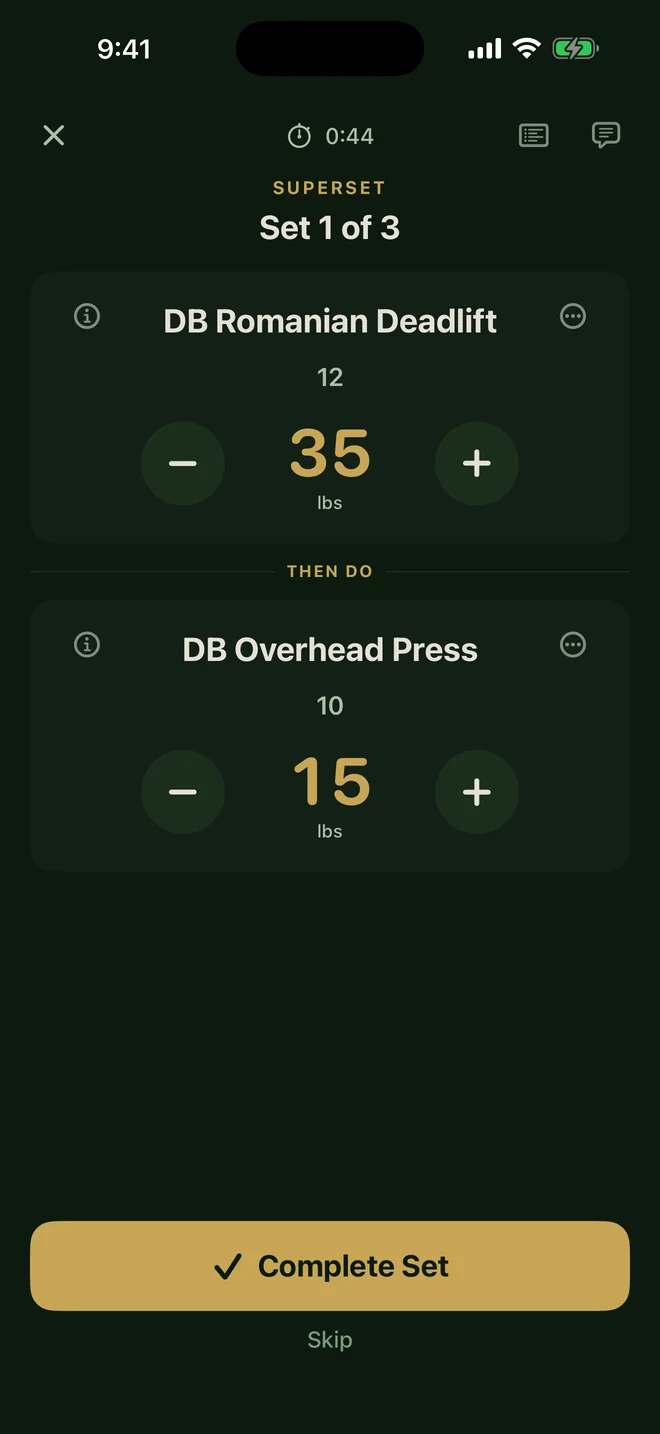
Open the app and it shows your first exercise, the target weight, and the target reps. Do the set and tap to finish it. The rest timer starts on its own, and when it ends the next set is already up. After the last set of an exercise, tap how hard it was from 6 to 10. That is one number per exercise, and it is the only thing you enter all session. Nothing gets typed, and there is no flipping between a plan, a stopwatch, and a notes app.
How does Measured decide what I do each session
Every Measured program is phased, and each session has a job. The program moves through phases, and each phase builds on the one before it, so the work compounds instead of resetting every week. You open the app and it shows the session, the exercises, the weight to use, and the reps to aim for.
How does Measured know when to add weight or reps
Two things drive it: your effort rating and a method called double progression. You train in a rep range, and when you reach the top of it with solid form, the weight goes up and the reps reset to the bottom. Your effort rating tells the app when you are ready and when to hold, so you are not adding weight on a fixed schedule. The program changes when your performance says it should.
What is RPE, and do I need to understand it
RPE is how you tell the app how hard an exercise felt, on a scale of 6 to 10. An 8 means you had about two reps left. A 10 means that was everything. Measured asks once per exercise, after your last set of it, so three sets of ten is one number rather than three. You learn the scale once and after that it is a single tap. Setting load from the reps you have left is a documented method rather than something we invented: it adjusts the weight to what you can do on the day instead of to a percentage of a max you tested months ago. Measured reads that number to decide when to push and when to hold, so the program stays calibrated to you on the day you actually train.
Read the full explainer on RPE
What are the phases in a program
A program runs in phases, and each one has a job. The 16-week Founder’s Program is a clear example: it builds a base in a hypertrophy phase, adds load through progressive overload, pushes intensity, then peaks so you see the results of the block. Shorter programs use fewer phases, but the idea holds: the plan has an arc, and every week is a step along it.
What if an exercise hurts, or I have an old injury
When you set Measured up you can flag a knee, shoulder, lower back, wrist or elbow, or neck problem. From then on the app suggests movements that avoid that area and train the same muscle another way, and it shows you each swap and the reason for it. You decide one exercise at a time: take the swap, or keep the original. Nothing is locked out, and you can replace or disable any exercise at any point in a program.
To be clear about what this is. The suggestions come from how the movements load the body, not from a clinician who has looked at your injury. Measured is not physical therapy, it does not diagnose anything, and it cannot tell you whether a movement is safe for you. If something hurts, stop, and talk to a professional before you train around anything serious.
What if I miss a workout, or a whole week
Miss a day and you can still train it. Open the Program tab, tap the day you missed, and start it. Nothing is lost inside the week you are in.
A whole week is different. The program runs on the calendar, so it keeps moving even when you do not, and the sessions you missed do not come back. If you start missing a lot, Measured notices and offers you a shorter program that fits the week you are actually having. There is also a travel setting that swaps in bodyweight work you can do in a hotel room, then puts you back on your program when you are home.
How does the Apple Watch app work
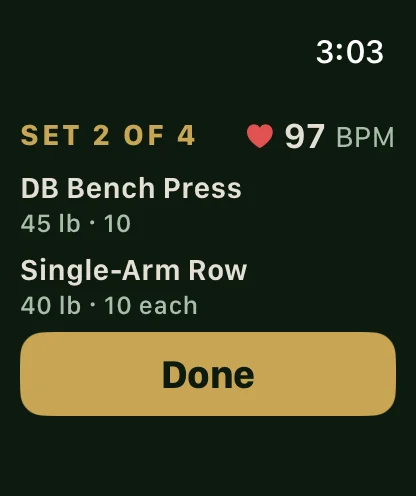
Start the workout on your iPhone, then follow the session from your wrist. The Apple Watch app shows the weight and the reps you are aiming for, lets you mark each set done, counts your rest down and buzzes on the last few seconds, and shows your live heart rate the whole time. Your Watch and iPhone stay in sync, and the finished workout writes to Apple Health as a real strength workout. Measured also has a watch-face complication, so the app is one tap from your wrist rather than a scroll through the app list.
Do I need an account
No. There is no account and no login. Your training data lives on your iPhone and in your own iCloud, so it syncs to your Apple Watch and stays with you. The AI that tailors your program never sees who you are. It gets your training answers and any limitation you flagged, as a plain category label like "knee". It never gets your name, your birthday, or any Apple Health data. If you delete the app, your data goes with it.
Where does the AI come in
The programs are structured, phased templates, and the AI works inside that structure rather than inventing a session. At the start it fits the program to you: it chooses movements for the equipment you own and leaves out any area you have flagged, and it shows you every substitution to review before you begin. From then on it reads your training history and tells you something you would not catch on a single screen, like how two lifts compare or how one has moved over several weeks. It stays quiet when it has nothing grounded to say. Your weights and reps do not come from it. Those are set by the app’s progression engine, from what you actually lifted and how many reps you had left.
The method these run on
None of the ideas underneath Measured are ours. They are the standard tools of strength programming, and the research behind the ones this page names is worth reading if you want to check the work.
- Setting load from reps in reserve. Helms, Cronin, Storey & Zourdos (2016), Strength and Conditioning Journal 38(4), 42–49. The scale Measured uses, and the case for adjusting load set by set to what you can actually do that day. Read it
- Why three good days a week is enough. Schoenfeld, Grgic & Krieger (2019), Journal of Sports Sciences 37(11), 1286–1295. A meta-analysis finding that training frequency does not meaningfully change muscle growth once weekly volume is matched. Read it
- Why a thirty-minute session still works. Iversen, Norum, Schoenfeld & Fimland (2021), Sports Medicine 51, 1491–1533. Pairing movements into supersets roughly halves training time while holding total volume, which is how the short programs are built. Read it
- What to expect from training in a deficit. Murphy & Koehler (2022), Scandinavian Journal of Medicine & Science in Sports. Eating at a deficit blunts gains in lean mass but not in strength, which is why the Cut is built to hold what you have rather than to add to it. Read it